
The baseline
A 2,000 sq ft code-built house in Augusta typically wants somewhere between 850 and 1000 gallons of oil a year, or the propane, pellet or cord wood equivalent. That is the number a percentage saving has to be measured against.
Home / Service Area / Maine / Augusta, ME
Maine's capital brings state and institutional work alongside a practical residential and small-commercial market.
Institutional · Kennebec County
River-valley sites, state facilities, I-95 access.
The lifecycle case is unusually easy to make in writing: a 425-year material life expectancy, a non-combustible assembly with two-hour fire-rated load-bearing tests, zero-waste manufacturing, 100% recyclability and an operating load 70–75% below a code building. The manufacturer is registered on SAM.gov and supplies government and military projects internationally.
What we typically supply in Augusta: State and municipal buildings, replacement housing, small commercial.
The arithmetic in zone 6A
Zone 6A runs roughly 7,000 to 8,000 heating degree days. A code-minimum wall spends a large share of that season conducting heat straight through its own framing.
A 2,000 sq ft code-built house in Augusta typically wants somewhere between 850 and 1000 gallons of oil a year, or the propane, pellet or cord wood equivalent. That is the number a percentage saving has to be measured against.
At an effective R-51 to R-61 with the studs thermally broken from the exterior face, heating energy typically falls 70 to 75%, on the order of 230 to 300 gallons. At current delivered prices that is thousands of dollars a year, every year the building stands.
A design load that low lets the mechanical system be sized at roughly half. Smaller equipment, smaller ductwork, less dedicated electrical service, and on solar-paired projects a smaller array and battery bank. That money never leaves the construction budget.
Baselines are typical for the climate zone and floor area, not a promise about your building. Send plans and we will run the numbers on the actual design.
Four products, one panel
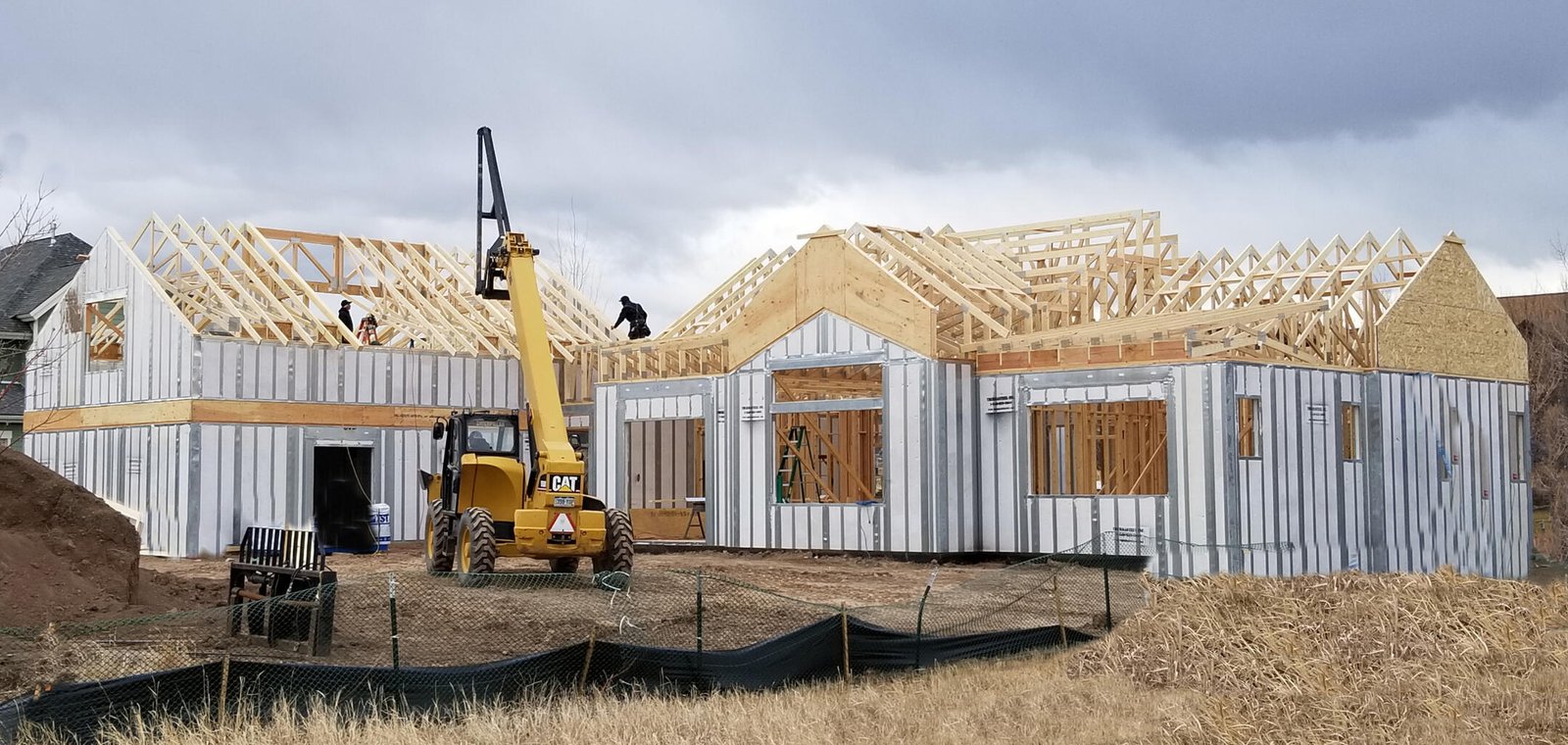
Each panel bonds light gauge galvanised steel structural members to EPS with a patented composite joining technology, and does the work of four separate trades. That is why the framing phase for an average house is about three days rather than three weeks.
5.5″ or 7.5″ thick, up to 4′ × 12′, effective R-51 to R-61, up to 42,000 plf LRFD, ready for direct application of the final cladding.
Load bearing, so trusses open to every 4–6 ft. Two panels connect at the ridge for cathedral ceilings and A-frames with no intermediate support.
3.5″ at R-28 for partitions, tiny homes and quiet rooms; ceiling panels pre-chased and ready for direct sheathing.
Concrete floor panels span up to 50 ft with minimal shoring and cut concrete volume by around 40%; below-grade panels are rated for foundation and retaining walls.
How it works
Architect’s drawings, a plan-service set, or a hand sketch with rough dimensions and a note about storeys and roof. We will tell you what is missing.
We panelize the building on paper and return a package and a delivered price to your Augusta site, no cost, and an honest comparison against building it the usual way.
Two to four weeks. Our drafters work with your architect and engineer: every panel numbered, every rough opening located, beams and headers integrated.
Panels arrive bundled in wall-line order with track, screws and hardware. One framer and two helpers close in an average house in about three days.
Code and compliance in Maine
Maine’s Uniform Building and Energy Code applies in most municipalities of any size, and a documented effective R-51 to R-61 assembly exceeds its envelope requirements comfortably.
IAPMO load tables for construction types II–V, signed and sealed by BEI Engineering. Up to 42,000 plf LRFD in bearing and 2,420 plf in shear with a 2.0 safety factor.
Two-hour load-bearing, one-hour load-bearing and two-hour non-load-bearing assemblies. EPS smoke and flame spread, self-ignition and flash ignition data. STC-rated assemblies for party walls.
Intertek thermal performance assessment, thermal zone map, ASTM E283, E331 and E330 air and water penetration testing, HUD Bulletin 1072 compliance and documented manufacturing tolerances.
Questions from Augusta
The manufacturer is SAM.gov registered and supplies government projects; documentation is on the resources page.
425-year material life expectancy, non-combustible assembly, 100% recyclable, operating loads 70–75% below code.
The manufacturer is SAM.gov registered and has supplied government and military projects in multiple countries. HUD Bulletin 1072 compliance and manufacturing tolerance documentation against HUD requirements are both published.
A 425-year material life expectancy, non-combustible assembly, 100% recyclable at end of life, zero-waste manufacturing with recycled content, and operating energy 70–75% below a code-built equivalent.
Sealed load tables, fire and STC test reports, ASTM air and water penetration testing, thermal performance assessment, connection details in PDF and AutoCAD, and the specification sheet. All of it is public on our resources page.
Yes. We supply the whole of New England from our base in Keene, New Hampshire, with panels manufactured in Radford, Virginia. Freight to Augusta is a quoted line item on the estimate, not a surprise at the end, and it is a small number against what the wall saves over the life of the building.
The panel package costs more than a lumber package. The finished wall usually costs less, because the panel replaces framing, insulation, sheathing and vapour barrier and cuts framing labour by roughly half, then the mechanical system shrinks by about 50%. We will price it both ways so you can see the whole picture rather than one line of it.
Send plans, a sketch or a description with rough dimensions to our team. You get a panel take-off and a delivered price at no cost, usually within a few days, plus a note on anything in the design that is fighting the system while it is still cheap to change.
Plans, a sketch or a napkin. We will tell you what the panel package costs delivered to your site, and what it saves against stick framing.