
Why a steel SIP package costs more than a lumber package but the finished wall often costs less: labour, trades, HVAC size, schedule and a free take-off.
It is the first question almost everyone asks, and the honest answer starts with a correction: the panel package on its own is the wrong thing to compare. What matters is the finished, insulated, sheathed wall, and what it costs to get there.
The package costs more than lumber
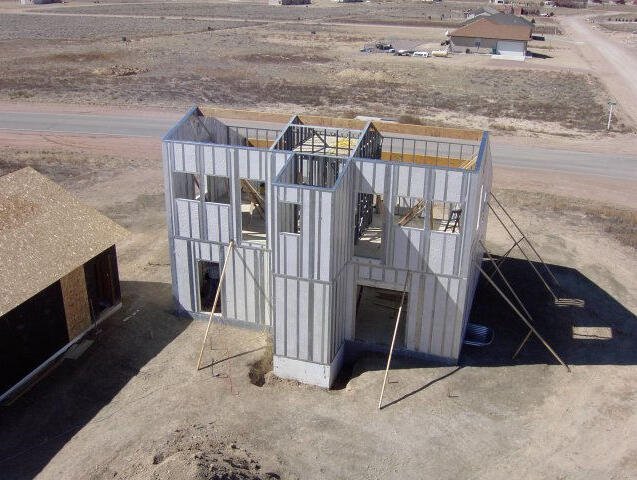
A ThermaSteel panel package costs more than a lumber package for the same building. That should not be a surprise, because the panel is doing four jobs at once. It is the structural framing, the insulation, the sheathing and the vapor barrier, delivered as one numbered piece. A lumber package is only the first of those four.
What the panel replaces
Put the other three back into the stick-built number and the comparison changes. A fair like-for-like includes:
- Framing lumber, plus the crew time to cut and stand it.
- Cavity insulation, plus the insulation contractor.
- Sheathing and its installation.
- The vapor barrier and the time spent detailing it around every opening.
Once those are counted, the finished wall usually costs less than the stick-built version. Framing labour alone drops by roughly half: one framer and two helpers typically close an average house shell in about three days.
The line items people forget
Trades. Four or five trades on the shell become one. Fewer trades means fewer schedules to line up and fewer return visits.
The heating and cooling system. With an effective R-51 to R-61 wall and no thermal bridging, the mechanical system can usually be sized at about half. That is money back on day one, before a single heating bill arrives. We explain the arithmetic in why we tell people to halve the HVAC.
Time. The building is weathertight sooner, which pulls every interior trade forward. On a financed project that is months of carrying cost, and on a rental or hospitality building it is an earlier first month of income.
Waste. Panels arrive pre-cut, numbered and bundled in wall-line order, with openings already made to the window schedule. There is no cut pile and no dumpster of offcuts to pay for.
Running costs. In a zone 6A winter, a well-built panel house typically uses 70 to 75% less heating energy than the code-built version of the same plan. That saving repeats every year the building stands.
What sets the price of a package
No two quotes look alike, because the price follows the building. The main drivers are:
- Wall, roof and floor area. Panels are priced by what they cover, not by the floor plan.
- Which parts you panelize. Walls only, or walls plus roof, floors and foundation. You can do as much or as little of the envelope as you like.
- Thickness. 5.5″ or 7.5″ exterior panels. We cover how to choose in 5.5 or 7.5 inch panels.
- Complexity. Curved walls, large glazed openings and cathedral roofs are all possible and are drawn in from the start.
- Freight. Delivery anywhere in New England is a quoted line item on the estimate, never a surprise at the end.
Why we do not quote a price per square foot
A per-square-foot figure hides almost everything above. It cannot tell you how much of the stick-built budget the panel replaces, how much smaller the heating system gets, or how many weeks come off the schedule. It is the easiest number to give and the least useful one to receive.
Instead, the estimate is free and comes with a comparison against framing plus insulation plus sheathing plus the labour for all of it, so you can see the whole picture rather than one line of it.
What to send for a price
- Architect’s drawings, a plan-service set, or a hand sketch with rough dimensions.
- The town the building is going to, so freight can be quoted.
- Which parts of the envelope you want panelized.
You get a panel take-off and a delivered price, usually within a few days, plus a note on anything in the design that is fighting the system while it is still cheap to change.
Building in New England?
Send plans, a sketch or a description. We will come back with a panel take-off and a delivered price at no cost. Get a free estimate →
Keep reading
Why we tell people to halve the HVAC, and what that saves on day one
The upfront equipment saving is the part of the panel budget most people forget to count.
Financing a low-energy build, and where lenders get stuck
The wall is the easy part. Appraisals and construction draws are where these projects lose momentum.
Twelve questions to ask any panel supplier, including us
If a supplier cannot answer these in writing, that is the answer.
Get a price on your project.
A panel take-off and a delivered price, at no cost, and an honest comparison against building it the usual way.