A lower heating load means a smaller solar array and battery bank. How a steel SIP envelope changes the maths of a net-zero or off-grid New England house.
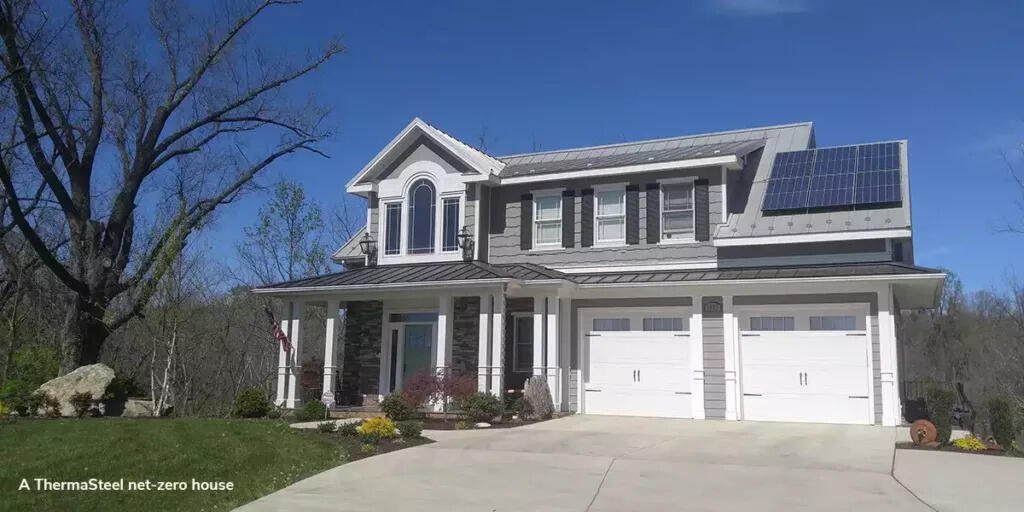
Net-zero sounds like a solar project. In a New England climate it is really an envelope project, because every unit of heat the walls and roof lose has to be made back by panels on the roof, and winter is exactly when the sun is shortest.
Start with the load
In a zone 6A winter, a well-built panel house typically uses 70 to 75% less heating energy than the code-built version of the same plan. On a house that would otherwise burn 900 gallons of oil a year, that is roughly 225 to 270 gallons. We walk through the heating arithmetic in what an R-61 wall does to a January heating bill.
Then size the array
Because the energy requirement is lower, a panel house needs fewer solar panels to reach net-zero, and the batteries that back them last longer. That saves on the initial investment and leaves more of the output to sell back to the grid in most locations.
A smaller heat pump
With an effective R-51 to R-61 wall and no thermal bridging, the mechanical system can usually be sized at about half. A smaller cold-climate heat pump draws less power, which feeds straight back into a smaller array. More on that in why we tell people to halve the HVAC.
Off-grid
Off-grid is the best case for it. Cutting the heating and cooling load by up to 75% means a smaller array, a smaller battery bank and a generator you rarely need to start.
Certification
For LEED for Homes, the performance path awards points on the HERS index, from zero for ENERGY STAR up to 34 points for a net zero energy home. Panels also earn points for framing efficiency, off-site fabrication and reduced waste; see our LEED credits page. If you are aiming at Passive House, read hitting Passive House in zone 6A. The envelope is the hardest part of either target; windows, ventilation and orientation remain your work.
Get the order right
Design the envelope first, then size the heating, then size the solar. Doing it the other way round buys roof panels to heat the outdoors. Send us your plans and we will run the wall against your design rather than a generic house.
Building in New England?
Send plans, a sketch or a description. We will come back with a panel take-off and a delivered price at no cost. Get a free estimate →
Keep reading
Hitting Passive House in zone 6A without building a thicker wall
Double-stud walls solve the R-value problem by getting fat. There is another way to get there.
Why we tell people to halve the HVAC, and what that saves on day one
The upfront equipment saving is the part of the panel budget most people forget to count.
What an R-61 wall actually does to a January heating bill in Cheshire County
Keene runs past 7,000 heating degree days a year. Here is what that means in oil, propane and cord wood when the wall changes.
Get a price on your project.
A panel take-off and a delivered price, at no cost, and an honest comparison against building it the usual way.